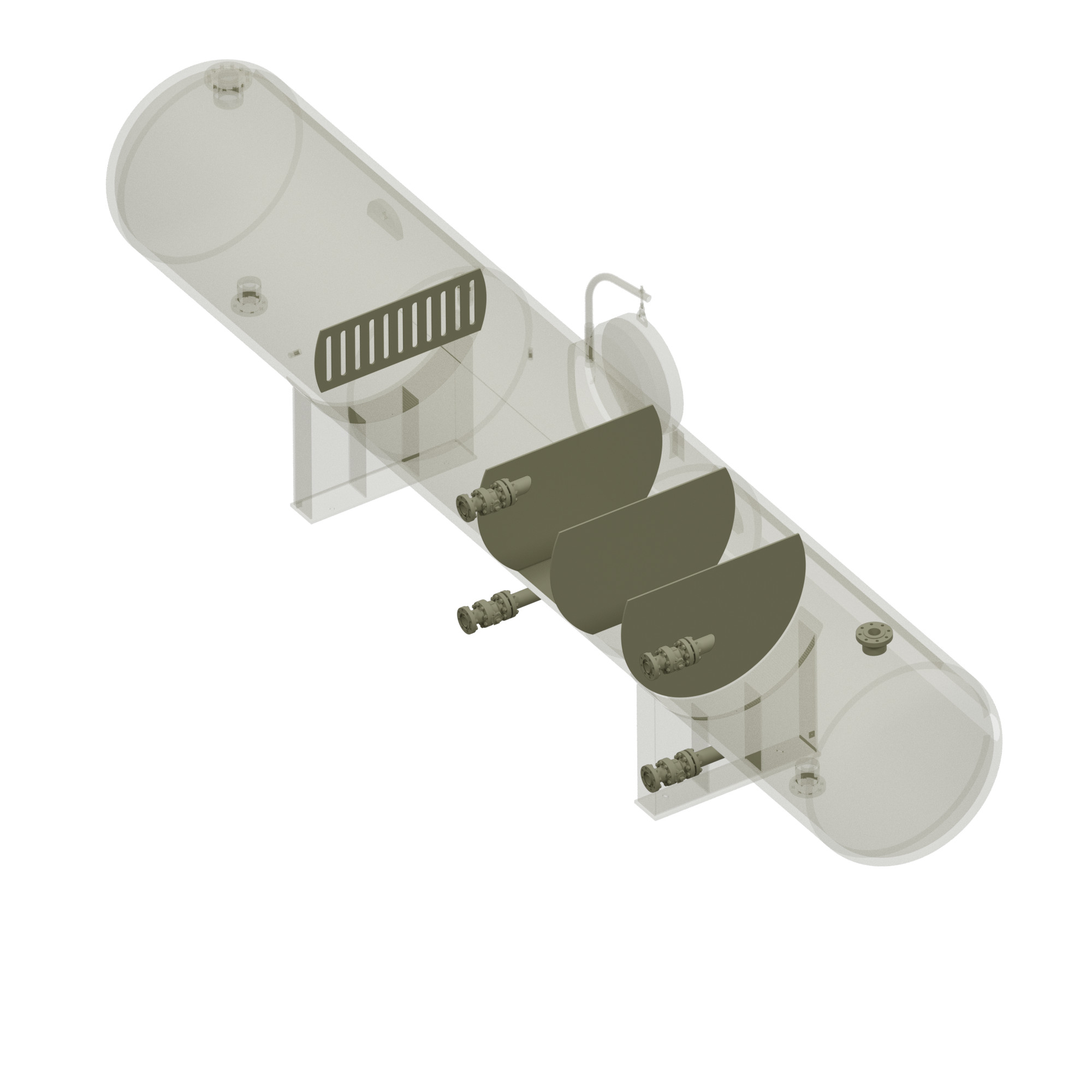
Description
Separators main function is to separate either gas-liquid known as 2-Phase separators, or gas-oil-water, which is known as a 3-Phase separation. This happens right after the emulsion has left the well head, before any metering, storage etc. has taken place.
Vertical Separators are typically selected when the gas-liquid ratio is high or total gas volumes are low. These vessels will conserve footprint area at the cost of retention time.
Horizontal separators are typically selected when large volumes of liquid are involved. These are preferred for 3-phase fluid flow. Better gravity separation is achieved in a horizontal vessel than in a vertical vessel because phases separate perpendicularly to the movement of the bulk phase; while the bulk phase flows horizontally in the vessel particle separation will occur vertically.
Different types of separations
Spill Over Weir:
This is Power Service’s standard design. Placement of control devices and construction is simple. The water outlet will be placed “in front” of the weir and the oil outlet will be placed “behind” the weir. Oil will spill over the weir when it has reached its full retention time, separating into pure oil. Water will be retained on the “front” of the weir and will exit the vessel when it has separated into purely water with the exception of any solids.
Split Head:
These types of internals allow fluid levels to be easily monitored from one end of the vessel. A weir is placed at the end of the vessel with two different heights to control water and oil levels as they spill into the collection area. It places level control devices side by side. Levels are controlled by weir heights and riser pipe if included, so the placement of controls is less critical that in the spill over weir configuration. Since the water and oil will be separated at one point the retention length of the vessel is greater than in a spill over weir; retention time of fluid can be extended without extending the length of the vessel.
Box and Weir:
The box will be the collection point for oil while water will flow under this box and hit the weir. The weir height will control the water level
Sizing:
Sizing of a pressure vessel for gravity settling will rely most heavily on the densities of the fluids and their flowrates. The selector in the Configurator will handle the main items needed to be taken into account when sizing a vessel, with the option of low, medium, and high PSIG, temperature and flow rates. Power Service works daily with customers to get specific separators designed depending on the customer needs, so if you require further configuration or a special system that is needing more in-depth engineering, you can work directly with our application specialist and engineering team at eSpec@dnow.com.